

FoundationsGuide 3 of 8
Foundation settling: what's normal and what's a problem
From Below the Sill · belowthesill.com/foundations/settling/
Short answer
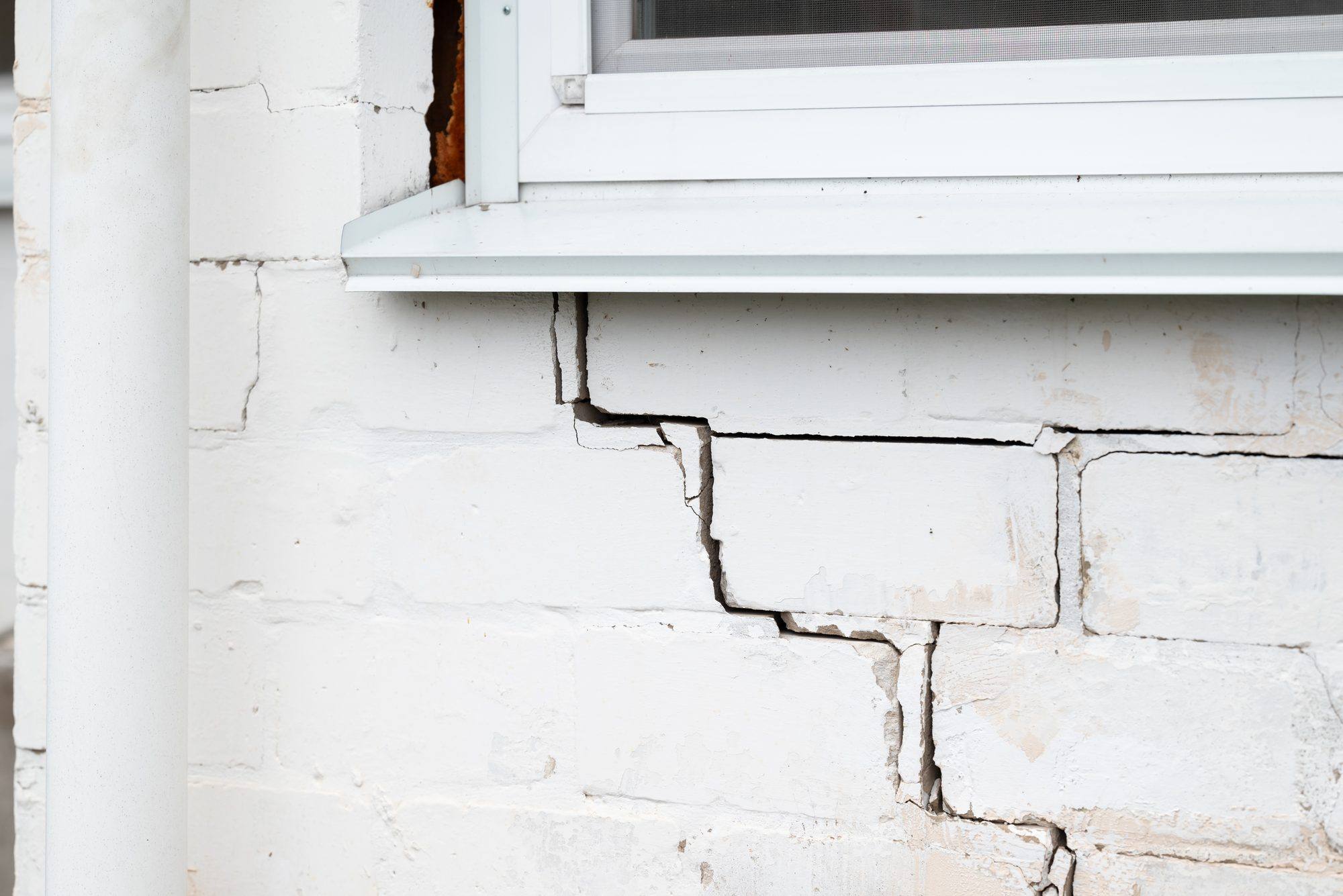
Foundation settling is when a house sinks a little as the soil under it compresses or shifts. Some settling is normal, and you’ll usually see it as fine cracks that stop changing. Uneven settling that keeps going is different, and it deserves a closer look: doors that stop closing, floors that slope a little more each season, or cracks that widen or shift out of line. No single crack width tells you whether a house is safe. The pattern, and whether it’s still moving, matter more.
On this page
What is foundation settling?
All houses sit on soil, and soil compacts under the weight of a house. If your house settles evenly, you may never know it happened. Our structural contributor, Daniel Mercer, says the houses that end up needing an evaluation usually have differential settling: one corner, one stretch of footing or one interior support goes down more than the rest. That pulls the house out of square and opens cracks between its parts. People often call all of this house settling, but it’s the uneven kind that matters.
Settling isn’t the only way a foundation moves. Heave works the other way: soil that swells or freezes pushes part of the house up. And if you have a crawl space and the floor slopes, it may not be the footing. Daniel often finds a sagging beam, a deteriorating post or wood weakened by moisture instead.
- Uniform settling: the whole house drops about evenly. Often few or no cracks.
- Differential settling: one part drops more. The house is pulled out of square and cracks open.
- Heave: soil that swells or freezes pushes part of the house up.
Why houses settle
The soil under a house changes for a handful of reasons:
- Fill that wasn’t compacted well. Soil brought in to level a lot can keep compressing for years.
- Water at the foundation. Downspouts that empty next to the wall, a yard that slopes toward the house, a leaking pipe or a sump pump that discharges a few feet away.
- Soil that swells and shrinks. Some soils change volume as they get wet and dry out.
- Frost. Freeze-thaw cycles move shallow soil, which matters more in colder states.
- Voids underground. Sinkholes in limestone areas (karst) and old underground mines can take support away from part of a house.
Water is one of the first things I look into. But finding water doesn’t mean it caused the settling. I separate three ways water can affect a foundation. It can wash soil out from under a footing. Soil can lose strength when it’s saturated. And some soils swell and shrink as they get wet and dry out. Water can also weaken wood supports without the footing moving at all.
I look for water that’s discharging near the foundation: downspouts, how the ground slopes when it rains, the end of the sump pump discharge line, standing water, washed-out soil, buried pipes and signs of moisture inside. I also ask when the cracks first showed up, and whether they get worse after rain or after a leak. A sump pump that discharges a few feet from the foundation can send the same water right back.
- Loose or poorly compacted fill under a footing
- A downspout emptying at the wall, with the yard sloping toward the house
- A leaking pipe washing out or softening the soil
- Soil that swells when wet and shrinks when it dries
- Frost depth: shallow footings above it can move
- An underground void: a sinkhole in limestone (karst) or an old mine
Here’s what’s worth checking in the states where Daniel and I work. These conditions show up in some areas, not everywhere:
| State | Conditions worth checking in some areas |
|---|---|
| Virginia | Poorly compacted fill, runoff at the footings, leaks, soils that change volume; karst in the Valley and Ridge, including the Shenandoah Valley |
| Pennsylvania | Fill, water and freeze-thaw; mine subsidence in coal and clay mining areas; karst where there’s limestone |
| Maryland | Fill and runoff; karst in the Frederick and Hagerstown valleys and other carbonate areas; soil washing out underground |
| Ohio | Frost, disturbed soils, drainage and fill; mine subsidence in some eastern and southeastern counties |
| North Carolina | Water under crawl spaces, fill and erosion; unstable slopes in the western mountains |
| Tennessee | Drainage, fill, changing soil moisture and karst, especially in Middle and East Tennessee |
| Kentucky | Karst and sinkholes, especially in the Bluegrass and Pennyroyal regions; drainage, fill and old mine areas |
| New Jersey | Urban fill, mixed soils, frost and drainage; some karst risk in the north and northwest |
None of this applies to every lot in a state. Daniel says conditions change more from one lot to the next than from one state to the next. If there’s any sign of an old mine, a void or sinking ground, he wants the soil investigated before anyone decides on piers.
Normal settling vs. a foundation problem
This is how Daniel sorts what he sees:
| What you see | Usually fine to watch | Worth a structural evaluation |
|---|---|---|
| A fine shrinkage crack, with no offset and no change | Yes | If it grows or runs through a structural element |
| A small crack at a drywall seam | Yes | If it keeps coming back along with doors out of square or a change in floor level |
| One door that rubs in summer | Check the door and the humidity first | If several doors change at once, or it keeps getting worse |
| A diagonal crack from a window corner | Depends on the pattern and how old it is | If it’s growing, opening or comes with a sloping floor |
| A stair-step crack in block or brick | Don’t assume it’s cosmetic | Yes, especially if the blocks or bricks have shifted |
| A horizontal crack and a bowing basement wall | No | Yes: this can be pressure from the soil outside, not settling |
| A gap between the floor and the wall or baseboard that keeps growing | No | Yes |
| An old floor slope that isn’t changing | Can be watched once it’s measured | If it’s getting steeper |
| A sudden drop, a large shift or a support that lost contact | No | Urgent: get it evaluated and keep people out of that area |
No single crack width tells you whether a house is safe. Daniel looks at more than that: the pattern, any offset, how the crack changes over time and what’s around it.
Signs of foundation settling
Inside the house:
- Several doors or windows that start to stick or fall out of square at the same time.
- Drywall cracks at the corners of doors and windows that come back after you patch them.
- Gaps between the floor, the wall or the baseboard that keep getting wider.
- A floor slope you can feel, especially one that’s getting worse.
Outside:
- Stair-step cracks in brick or block, especially where the units have shifted.
- Diagonal cracks running from the corners of windows and doors.
- Gaps around window and door frames.
Any one of these on its own may not mean much. When several show up together and keep getting worse, that’s when Daniel gets concerned.
Settling cracks: which ones are normal
Hairline shrinkage cracks that aren’t growing are typical in concrete and usually aren’t a sign of settling. A stair-step crack in a block or brick wall shouldn’t be dismissed as cosmetic, especially if the blocks have shifted. A horizontal crack in a basement wall that bows into the house usually comes from soil pressure, not settling. That’s a different problem, covered in our guide to bowing basement walls.
For how to read each type, see our guide to foundation cracks.
How much settling is acceptable?
There’s no magic number. A 1-inch (25 mm) difference between two points on your floor is just that: a measurement, not a diagnosis. You need to know whether the house was built that way, whether the floor framing is sagging, or whether the foundation itself has moved.
Engineers take relative elevations across the floor with a laser or a level. They set fixed reference points and come back months later to measure again. They also check walls for lean and bowing, measure cracks and inspect the supports.
Some engineering groups have published criteria. A 2007 guideline from the Foundation Performance Association in Houston recommends that tilt across a foundation stay at or under 1%, and that deflection stay within about L/360 (the span length divided by 360). It was written for Texas, though, and says to use it with caution elsewhere. No building code says that a crack this wide means you need piers. The International Residential Code requires footings that carry the house’s loads to suitable soil, and ground that slopes water away from the foundation. In the end, it comes down to whether your house is still moving.
How to track movement
If the signs are mild and nothing looks dangerous, Daniel suggests this:
- Photograph each crack with a ruler in the shot, the date, and the same angle every time.
- Mark two or three permanent points and record the width and length.
- Sketch a simple floor plan with the cracks, the doors that rub and any slopes.
- Note heavy rain, dry spells, leaks and any digging or construction nearby.
- Take a first reading, another after a month, then every three months for 6 to 12 months, if a professional thinks it’s safe to watch.
That schedule is a rule of thumb, not a code requirement. If the readings start changing faster, a wall looks like it’s leaning, or a support has lost contact, don’t wait for the next reading. There’s more on measuring cracks in how to monitor a crack.
Foundation settling repair: how it’s fixed
Repair starts with the cause. If you can find it and fix it, that may be most of the job.
When the house keeps settling, the usual fix is to carry the foundation down to firmer soil with piers or, for floor slabs, to lift them:
| Method | When it can make sense | Limits and risks |
|---|---|---|
| Push piers (steel piers driven down) | A foundation heavy enough to push against, with firmer soil deeper down | The house and footing have to handle the installation force; depth is set by capacity, not habit |
| Helical piers (screwed into the soil) | Loads and soils where a screwed-in pier makes sense, including lighter structures | The system, its capacity, installation torque, corrosion and the bracket all need checking |
| Mudjacking (grout under a slab) | A non-structural slab that lost support or sank | It doesn’t support footings; it adds weight and doesn’t fix deep movement |
| Polyjacking (foam under a slab) | A slab suited to lifting, with voids or localized settling | It doesn’t replace stabilizing the foundation or deep soils |
| New posts, footings and shims in a crawl space | Weak interior supports, a bad post or a lost connection | Loads and soil need checking first; a shim won’t fix a footing that keeps sinking |
| Underpinning with concrete, in sections | When a footing needs to be made wider or deeper | Shoring, digging in stages and the right sequence; done badly, it can cause settling |
- Bracket attached to the footing
- Steel pier, driven down using the house’s weight to push against
- Helix plates: the pier is screwed in, and the installation torque is recorded
- Firmer soil the piers are meant to reach
You don’t always have to lift a house back to level. Lifting it can open new cracks and shift walls, pipes and windows. Often the reasonable goal is to stabilize the house and bring it back only part of the way.
For prices, see foundation repair cost.
When to call a structural engineer
A contractor can handle sealing or a simple repair when it’s obvious what needs to be done. When the plan involves piers, underpinning, new supports, straightening a wall, lifting the house or correcting active movement, Daniel wants an independent structural engineer to define the problem and the scope first. If the soil itself is the unknown, a geotechnical engineer should be consulted too.
He wouldn’t automatically avoid a company that both diagnoses and repairs, but he’d keep the conflict of interest in mind. You can’t compare a quote for eight piers with one for four on price alone, until you know what the piers will carry, where they’ll go and how they were designed. More on that in how to compare foundation repair quotes.
Structural information reviewed for technical accuracy by Daniel Mercer. This content is educational and is not a substitute for an on-site evaluation by a licensed professional engineer.
Who wrote this guide
Written by
Licensed contractor in Virginia who specializes in moisture, water, mold and radon.
- Five IICRC certifications, including Building Moisture Inspection and Mold Remediation Specialist
- Virginia contractor license, Residential Building Contractor (RBC) class
- NRPP certified Radon Measurement Professional (2018) and Radon Mitigation Specialist (2020)
- EPA RRP Certified Renovator (lead-safe renovation)
Structural review
Daniel Mercer, Structural Contributor
Reviews the structural information in this guide for technical accuracy.
- Civil engineering graduate, Virginia Tech (2008)
- More than 17 years evaluating existing homes in Virginia
Below the Sill is independent and educational. We don’t provide inspections, engineering or repair services, contractor referrals or estimates.
Share this guide
All 8 guides in Foundations
Foundations topic pageA seasonal check, by email
Four emails a year, before each season changes: what to look at in your basement, crawl space and yard, and the guides we’ve published since the last one.
Sources
- International Code Council, 2024 International Residential Code, Chapter 4: Foundations (opens in a new tab). Checked October 2026.
- Foundation Performance Association, Guidelines for the Evaluation of Foundation Movement for Residential and Other Low-Rise Buildings, FPA-SC-13-0 (opens in a new tab) (2007). Checked October 2026.
- Maryland Geological Survey, Foundation Engineering Problems in Karst (opens in a new tab). Checked October 2026.
- Virginia Energy, Sinkholes and Karst (opens in a new tab). Checked October 2026.
- Pennsylvania DCNR, Sinkholes (opens in a new tab). Checked October 2026.
- Ohio Department of Natural Resources, Mine Subsidence (opens in a new tab). Checked October 2026.
- Kentucky Energy and Environment Cabinet, Karst Geology (opens in a new tab). Checked October 2026.
- U.S. Geological Survey, Sinkholes (opens in a new tab). Checked October 2026.
Field cases come from Daniel Mercer’s own work. To keep the owners anonymous, each case names only the state. Below the Sill doesn’t sell repairs or send them customers.