
Mold on wood: joists, subfloors and sill plates
Short answer
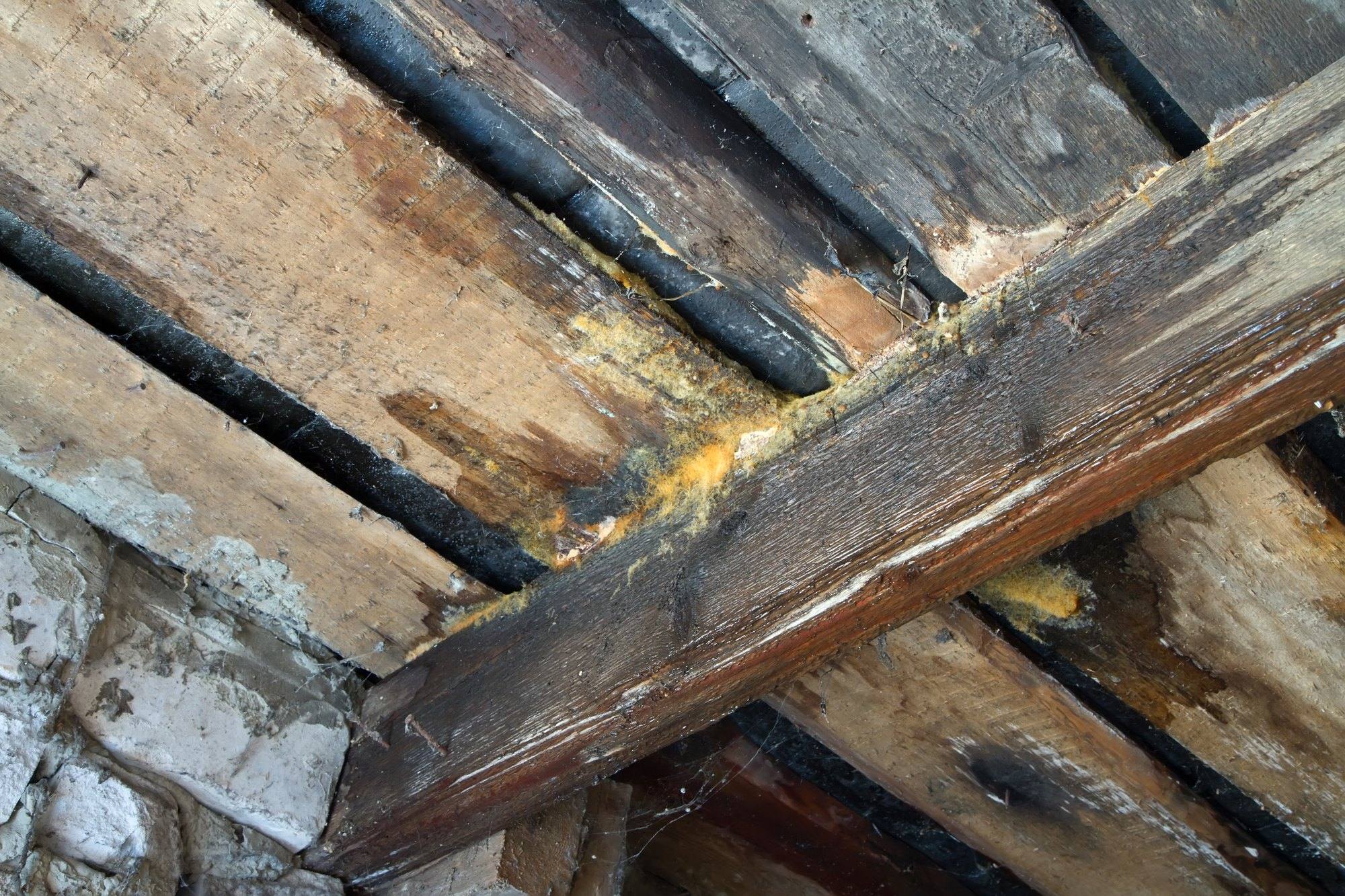
Most of the time, mold on joists, subfloors and sill plates is growing on top of wood that’s still solid, and you can clean it once the moisture problem is fixed. Rot is different: the wood is breaking down and losing strength, and you can’t clean rot away. Before you start cleaning, check whether the wood is solid and find out what made it wet. Soft or crumbling wood, missing wood, a crushed sill plate or a sagging floor make it a structural problem, not just a mold job.
On this page
Mold, stain or rot?
The first thing I look at is whether the wood still holds together.
| Surface mold | Staining | Rot (decay) | |
|---|---|---|---|
| What it is | Growth on top of the wood | A change in color | The wood itself breaking down |
| What you see | Growth on the surface; the wood underneath is solid | Discoloration, maybe with no active growth | Soft or crumbling wood, distinctive cracking, missing material |
| Strength | Not affected | May not be affected | Being lost |
| What it needs | Fix the moisture, then clean | Fix the moisture; the stain may stay | Fix the moisture and get the structure evaluated |
Scroll sideways to see the whole drawing.
The probe test
I take an awl or a small screwdriver and probe the wood in question, carefully: I don’t want to push through a good joist. I probe sound wood nearby too, to feel the difference. If the point goes in easily where the joist should be solid, that concerns me.
It gives you some guidance, but it won’t tell you how much strength is left.
What moisture meter readings mean
I mostly use a pin-type meter. I also have a pinless meter that I scan an area with to find differences. But when I need to check a specific spot, I use the pin meter.
| Reading | What I do |
|---|---|
| 12–16% | Nothing special for framing inside a house |
| 16–19% | Look at the context |
| 20% or more, sustained | Find out why |
| 25–30%, for a while | I’m quite concerned |
These are the numbers I use in the field, not legal limits. Temperature, the type of wood, treatments and how deep you measure can all change the reading. And 28% doesn’t mean your wood is rotted.
The research lines up with that. A paper by Morris and Winandy, listed by the USDA Forest Service, says wood decays above 30% moisture content and doesn’t decay below 20%, with a gray area in between.
How to remove mold from wood
Fix the moisture first. There’s no point in doing anything else if you don’t. Then figure out how much growth there is and whether it needs containment.
On a professional job I may use:
- A HEPA vacuum, once the material is dry enough and the dust is under control.
- Mechanical cleaning of the surface, when it’s needed.
- Damp cleaning, careful not to soak the wood again.
- Light abrasion of the surface, in some cases, with extraction equipment and containment.
I don’t like sanding moldy wood in an open crawl space and letting the dust go wherever it goes. Soda blasting and dry ice blasting have their place, but I don’t believe every joist with a stain needs to be blasted. They have risks too, and they can damage the surface of the wood. The EPA’s remediation guide includes wood among the surfaces that can be cleaned, with the method matched to how much area is affected.
If you’re a homeowner, keep it to a small area you can reach easily, with no hidden damage and no structural issues. I wouldn’t tell anyone to go under their house and sand 20 joists. Mold in basements covers protection and the limits of doing it yourself, and mold in crawl spaces walks through how a professional job works.
Antimicrobials and encapsulants
I use them sometimes, but they’re not what the job is built around. An antimicrobial can be part of a specific procedure. What I won’t accept is spraying something on wood that has visible growth and calling the job done. The EPA doesn’t recommend biocides as a routine part of mold remediation either.
An encapsulant can make sense after the wood has been cleaned, dried and checked. I don’t use it to cover mold or to make rotted wood stronger. Just because it’s painted white doesn’t mean the problem is solved, and the EPA warns that paint over moldy surfaces is likely to peel.
New lumber that got wet during construction
First, make sure it stops getting wet. Then find out how far the water got in and how long the wood was wet. If there’s mold on the surface, clean it with a proper procedure. Then dry the wood and test it again.
I don’t want to see drywall go up over wet framing. I also don’t want to see someone replace all their wood because it got rained on. If it’s solid, it can be fine. If it swelled a lot, delaminated, rotted or lost strength, that’s a different story.
When mold on wood becomes a structural problem
When the wood no longer seems to have its original strength, I stop treating it as only a mold remediation job. The signs:
- visible loss of material;
- soft or crumbling wood;
- deteriorated joist ends;
- damage where joists bear on a beam, wall or sill;
- a crushed sill plate;
- a rim joist that has lost material;
- connections that no longer hold well;
- a beam that has deformed;
- a sagging floor;
- posts that are giving way.
Rot on a joist right where it bears on its support concerns me much more than a spot in the middle of the joist.
That’s where I want Daniel Mercer, our structural contributor, or another qualified structural professional, to come in. Daniel looks first at where the damage is, not only how much there is. A joist rotted near its bearing point can be a bigger issue than a larger stain somewhere else. He looks at:
- how deep the damage goes;
- how much of the cross-section is lost;
- how long the damaged area is;
- whether it’s at a support or a connection;
- whether the wood is being crushed;
- deflection, or how much the piece bends;
- cracks linked to lost material;
- what load the piece carries.
He doesn’t use a universal rule like “if it’s lost less than 10%, you can leave it.” A joist that has lost material at a highly stressed point may need work even if the damage looks small. A sill plate being crushed under a bearing wall is a serious concern. He also checks whether the rot is active or old damage that has dried out: just because it’s dry now doesn’t mean it got its strength back.
Common repairs
These aren’t interchangeable. Which one fits depends on what Daniel finds:
- Sistering a new joist alongside the old one, when the original needs reinforcement and the load can be properly transferred to the new piece.
- Replacing the joist, when the damage is too extensive or the piece can no longer do its job.
- Repairing the joist end, when the problem is limited to where it bears and a repair can be designed to restore the capacity it needs.
- Replacing the rim joist, when the edge of the floor system has lost material or can’t carry loads.
- Replacing the sill plate, when the board on top of the foundation is rotted, crushed or no longer gives proper support. See sill plates and rim joists.
- Reinforcing or replacing a beam, when the main member has lost capacity.
- Repairing a post or footing, if there’s also movement or not enough support.
What not to do with rotted structural wood
- Cut out a rotted structural piece without knowing what it’s holding up.
- Remove a post because it’s in the way.
- Take out a long section of sill plate without proper shoring.
- Fill rotted wood with putty or epoxy and assume it’s strong again.
- Screw a new piece of wood over a destroyed one without working out how the loads get transferred.
- Paint over rot.
- Leave a temporary jack in place as a permanent support without a proper design.
Daniel also tells people not to try to lift a sagging floor themselves. Cleaning mold off solid wood is one thing. Repairing the structure that holds up your house is something else.
Structural information reviewed for technical accuracy by Daniel Mercer. This content is educational and is not a substitute for an on-site evaluation by a licensed professional engineer.
Sources
- Paul I. Morris and Jerrold E. Winandy, Limiting conditions for decay in wood systems (opens in a new tab) (International Research Group on Wood Preservation, 2002; listed by the USDA Forest Service): decay above 30% moisture content, none below 20%, a gray area in between.
- EPA, Mold Remediation in Schools and Commercial Buildings, Chapter 5 (opens in a new tab) (updated April 14, 2026): cleanup methods for wood surfaces by size of the affected area.
- EPA, Mold Remediation in Schools and Commercial Buildings, Chapter 3 (opens in a new tab) (updated April 29, 2026): biocides not recommended as routine practice; paint over moldy surfaces likely to peel.
Robert Stulpt holds the IICRC Applied Microbial Remediation Technician (AMRT) and Mold Remediation Specialist (MRS) certifications and owns a remediation company in Virginia. Below the Sill doesn’t send him customers.
The structural criteria, repairs and what not to do come from Daniel Mercer’s residential work in Virginia.