

Home hazardsGuide 7 of 8
Asbestos in the basement: pipe insulation, boilers and ducts
From Below the Sill · belowthesill.com/asbestos/basement/
Short answer
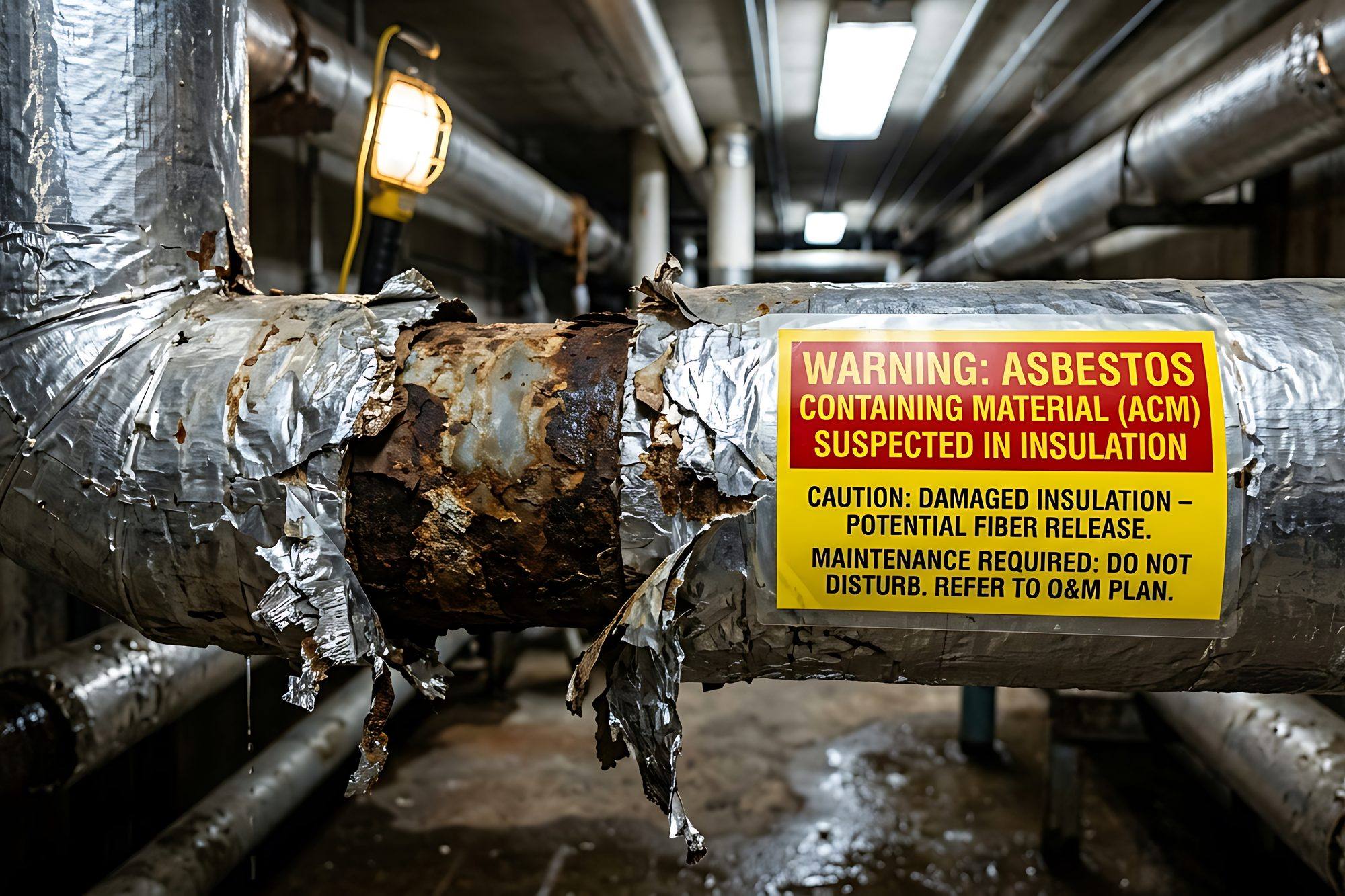
In homes built before about 1980, asbestos in the basement usually shows up in the white or gray insulation wrapped around old heating and steam pipes, especially at the elbows. It can also be on old boilers and furnaces, in some duct tapes and cements, and in transite (asbestos-cement) pipes and ducts. There’s no way to know by looking: only a lab test of a sample confirms it. If the material is in good shape and you’re not planning to disturb it, the EPA says leaving it alone is usually best. Before replacing a boiler, remodeling or working in the crawl space, have it inspected and sampled by a professional.
On this page
- Where asbestos hides in a basement
- What asbestos pipe insulation looks like, and why looks aren't enough
- Is it dangerous if you leave it alone?
- Before you replace a boiler, renovate or encapsulate a crawl space
- Testing: who takes the samples
- Repair, encapsulation or removal
- Rules: federal, state and local
- Will insurance pay for asbestos removal?
Where asbestos hides in a basement
Our asbestos contributor, Graham Whitlock, says these are the materials that most often make him stop a basement renovation:
| Where | What it usually looks like | Risk if left alone | What to do |
|---|---|---|---|
| Heating and steam pipe insulation, elbows and valves | White or gray wrap, corrugated “aircell” or a hard plaster-like coating, often with a canvas cover | Low while intact; higher where it’s frayed or crumbling | Don’t disturb it. Get it tested before any work near it |
| Old boilers and furnaces | Insulation or a hard coating on the outside of the unit | Low while intact | Test before the unit is removed or replaced |
| Duct tape, cements and joint compounds on ducts | Gray or white tape or paste at duct joints | Low while intact | Test before ducts are removed or sealed |
| Transite pipes and ducts | Gray, cement-like pipe, sometimes for a sewer, water line or buried duct | Low while intact; dust if cut or broken | Don’t cut, drill or break it |
| Heat-resistant panels and old coatings | Boards near heaters, old textured coatings | Varies | Test before removal |
| Floor tiles and black mastic | Often 9 x 9 in tiles with dark adhesive | Low while intact and stuck down | See asbestos floor tiles |
- Pipe insulation, especially at elbows and valves
- Insulation or coating on an old boiler or furnace
- Tape, cement and joint compound on ducts
- Transite (asbestos-cement) pipe or duct
- Floor tiles and the black mastic under them
What asbestos pipe insulation looks like, and why looks aren’t enough
When Graham comes across a pipe elbow with white insulation that’s fraying, he won’t tell you it’s asbestos because of the color. He notes where it is, whether it’s damaged and what work will disturb it. Until the material is identified, his advice is simple: don’t scrape it, pull it off or vacuum it up with a household or shop vacuum.
Age and appearance give you hints, not an answer. Some older insulation contains asbestos and some doesn’t, and newer products can look the same. The only way to know is a lab test of a sample, usually polarized light microscopy (PLM) for building materials.
Is it dangerous if you leave it alone?
The risk comes from fibers released into the air, not from the material just being there. The EPA’s guidance for homeowners is that the best thing is usually to leave asbestos-containing material alone if it’s in good condition, and that material that is intact and won’t be disturbed doesn’t need testing.
If it’s in good condition, out of the way and nobody will disturb it, Graham’s first choice is usually to leave it and note where it is. He won’t have someone remove stable material just because it was found. If it’s slightly damaged, watch it for wear and keep people away from it.
Before you replace a boiler, renovate or encapsulate a crawl space
This is when asbestos matters most, because the work itself disturbs it. Graham’s order:
- Stop. Don’t let anyone take apart suspect material.
- List what the work will touch: pipes, coverings, ducts and floors.
- Inspection and sampling by a qualified professional, with analysis by an accredited lab.
- Share the results with the heating contractor or the renovation crew.
- If anything has to come out, that removal goes to a licensed abatement contractor as a separate job, with its own control plan, waste handling and final check.
Don’t cover deteriorated pipe insulation with spray foam that will hide it. Covering it doesn’t make it go away; it just makes it harder to deal with later.
Testing: who takes the samples
The EPA recommends that a trained and accredited asbestos professional take the samples, not you. Sampling can release fibers, and a poor sample may not give an accurate result. Each sample should be labeled with where it came from, the material and layer sampled, the date and a chain of custody.
Graham uses a lab accredited under the NIST National Voluntary Laboratory Accreditation Program (NVLAP) to test bulk building materials for asbestos, and he checks which of its locations will analyze the sample, not just the company name. Air testing uses different methods, so a lab accredited for bulk samples isn’t automatically accredited for air.
Repair, encapsulation or removal
- Leave it in place when it’s intact, hard to reach and won’t be disturbed.
- Encapsulate or protect it when the material and its use allow it, with a method made for that product, and never to hide damage that’s getting worse.
- Remove it when it’s crumbling or coming apart, when work will disturb it, when it can’t be protected from damage, or when it’s in the way of a repair that has to happen.
Removal is a regulated job for a licensed contractor. It starts by defining the material, the quantity, the access and the class of work. Living areas are protected, and any HVAC that could spread dust is sealed off. Depending on the job, that can mean containment with HEPA filtration and negative air pressure. The contractor removes the material, cleans up, then bags, labels and takes the waste to an approved disposal site. At the end, the paperwork, the visible cleanup and any final checks the plan or the state requires are reviewed.
Not every home requires final air testing. In Virginia, for example, the rule that has project monitors take final air samples on abatement projects makes an exception for residential buildings.
Rules: federal, state and local
Asbestos rules for houses are a patchwork:
- Federal. According to the EPA, federal law doesn’t require the people who inspect, repair or remove asbestos in detached single-family homes to be trained and accredited, though some states and localities do, and the EPA recommends hiring trained, accredited professionals. The federal asbestos air rule (NESHAP) covers demolitions and renovations but excludes residential buildings with four or fewer units. That’s separate from OSHA worker rules, state licensing, disposal rules and local permits.
- Virginia. Asbestos inspectors, supervisors, project monitors, contractors and labs are licensed under 18VAC15-21. What applies to a residential project has to be checked job by job.
- Maryland. The Maryland Department of the Environment says friable asbestos in single-family homes is regulated during renovation or demolition, except when homeowners do the work themselves. Check the rules before you hire anyone.
- Pennsylvania. The Department of Environmental Protection doesn’t regulate asbestos removal from private residences with fewer than five units, but that doesn’t remove the Department of Labor & Industry’s certification rules or local ones. Ask your township or borough.
- Other states. Don’t assume one state’s rules apply in another. In North Carolina, start with the Health Hazards Control Unit’s guidance before you renovate or demolish.
Will insurance pay for asbestos removal?
Not just because it’s there. Finding asbestos pipe wrap or floor tiles in a basement doesn’t oblige your insurer to pay for removing them, and many policies exclude pollutants outright.
The exception is damage from a covered event. If a covered loss, such as a burst pipe or a fire, damages materials that contain asbestos, some of the work needed to repair that damage safely may be covered, depending on the policy’s exclusions. As with mold, the cause of the damage matters. But asbestos has its own exclusions, cleanup provisions and safety requirements, so a covered fire or water loss doesn’t automatically mean every abatement cost will be paid.
Either way, don’t disturb suspect materials to see what’s under there or to clean up after water damage. Have them assessed first, and use qualified professionals for any removal. Insurance information reviewed by Nathaniel Calderbrook; coverage depends on your policy wording and your state.
Asbestos information reviewed for technical accuracy by Graham Whitlock. This content is educational and is not a substitute for an inspection and lab testing by an accredited asbestos professional in your state.
Who wrote this guide
Written by
Licensed contractor in Virginia who specializes in moisture, water, mold and radon.
- Five IICRC certifications, including Building Moisture Inspection and Mold Remediation Specialist
- Virginia contractor license, Residential Building Contractor (RBC) class
- NRPP certified Radon Measurement Professional (2018) and Radon Mitigation Specialist (2020)
- EPA RRP Certified Renovator (lead-safe renovation)
Asbestos review
Graham Whitlock, Asbestos & Environmental Safety Contributor
Reviews the asbestos information in this guide for technical accuracy.
- Licensed Asbestos Inspector and Asbestos Project Monitor, Virginia DPOR
- Asbestos inspector accreditation in Maryland and Pennsylvania
- B.S. in Environmental Science, Virginia Tech; 22 years in asbestos inspection and project oversight
Below the Sill is independent and educational. We don’t provide inspections, engineering or repair services, contractor referrals or estimates.
Share this guide
All 8 guides in Home hazards
Home hazards topic pageA seasonal check, by email
Four emails a year, before each season changes: what to look at in your basement, crawl space and yard, and the guides we’ve published since the last one.
Sources
- U.S. EPA, Protect Your Family from Exposures to Asbestos (opens in a new tab) (updated June 25, 2026). Checked October 2026.
- U.S. EPA, Asbestos Laws and Regulations (opens in a new tab) (updated December 11, 2025). Checked October 2026.
- OSHA, Asbestos standard for construction, 29 CFR 1926.1101 (opens in a new tab). Checked October 2026.
- Virginia Administrative Code, 18VAC15-21-470, Asbestos project monitoring (opens in a new tab). Checked October 2026.
- Maryland Department of the Environment, Asbestos for Homeowners (opens in a new tab). Checked October 2026.
- Pennsylvania DEP, Asbestos (opens in a new tab). Checked October 2026.
- NC DHHS Health Hazards Control Unit, Before You Demo, Renovate and Remove Asbestos-Containing Materials in NC (opens in a new tab). Checked October 2026.
- NIST, NVLAP Asbestos Fiber Analysis (opens in a new tab) (updated July 17, 2026). Checked October 2026.
Rules and sources checked October 2026. Field cases come from Graham Whitlock’s own work; each names only the state to keep the owners anonymous. Below the Sill doesn’t offer asbestos testing or removal, or send customers to anyone.